
Forest County Projected Versus Actual Release
A projected date is a forecast based on information available at that time. An actual release date records a completed exit from one custodian. Final discharge means the sentence or supervision obligation has ended. Those dates can differ. A release to state parole is actual institutional release, but the state sentence continues under supervision. A transfer is neither community release nor discharge.
Pretrial custody works differently. A person held on a Forest County matter may leave after bail, dismissal, acquittal, or another order, yet another detainer can keep that person confined. Forest County publishes no jail, contract-facility, or local sentence-calculation page. The Sheriff must first identify the actual holding custodian, and that facility must explain its own operational date.
- Judicial minimum
- The ordinary first point at which parole may be considered, subject to law and the sentence.
- Maximum
- The sentence-expiration point unless a lawful change or another custody basis applies.
- Board Action
- The individual Parole Board record stating a grant, refusal, deferral, rescission, or other result.
- Detainer
- A hold tied to another case, warrant, sentence, or agency.
Find Forest County Projected Release Dates
Begin by deciding whether the person is a local defendant, a Pennsylvania state prisoner, or a federal detainee. “Forest County inmate” is not enough. SCI Forest is a PADOC prison, while the county site does not name a local jail. Search the court and custody systems that match the legal authority.
- Find the Forest County case in UJS Case Information. Record bail, sentence, confinement, minimum, maximum, probation, and later-order labels exactly.
- For a local arrest, call the Forest County Sheriff and ask which facility physically held the named person on the relevant date. Request that custodian's existing computation or release record.
- For an SCI Forest or other state case, open the PADOC locator gateway. Confirm identity and current institution on the inmate side.
- If parole is reported, search the parolee side and read the actual Release Date, location, district office, and last-update fields. Do not call that date projected.
- Use the individual Board Action and the sentencing order for parole authority and eligibility. Ask PADOC for authoritative sentence computation when the public display is insufficient.
The official PADOC locator scope page documents a daily-updated inmate and parolee search:
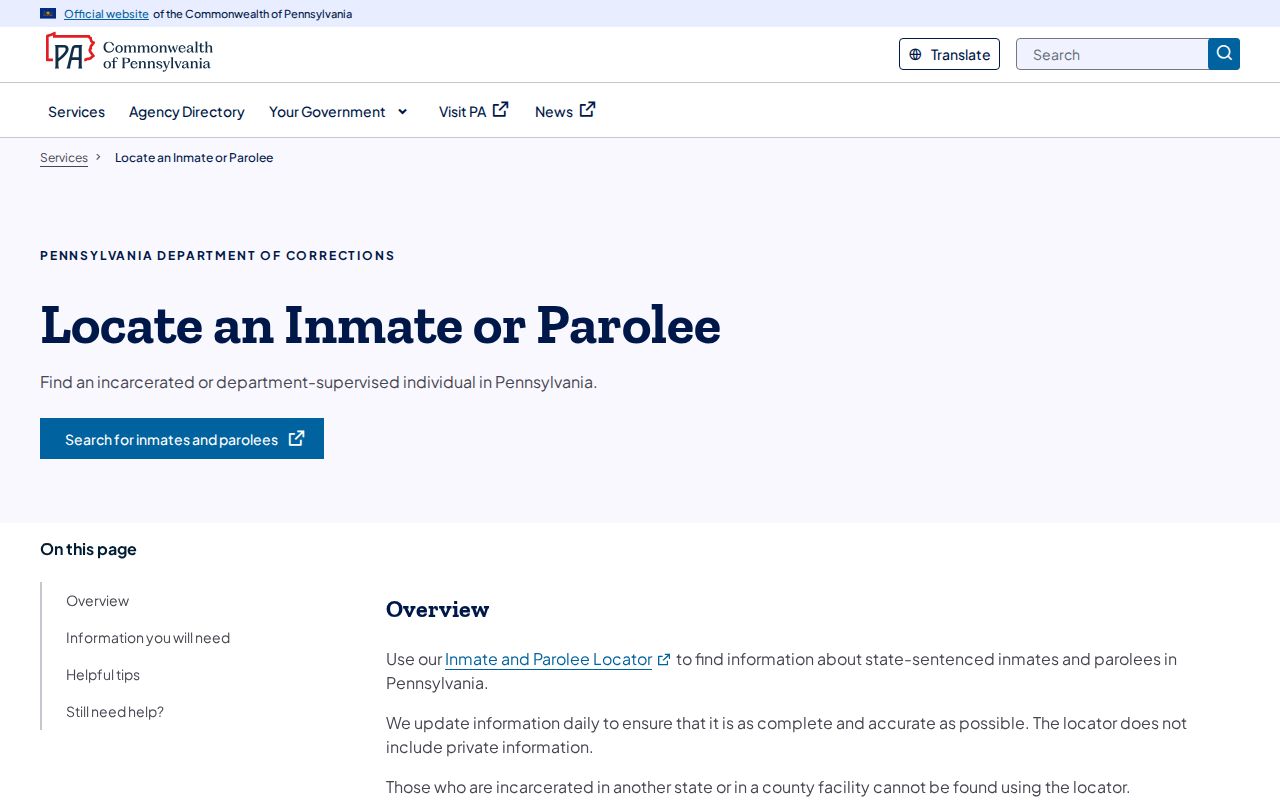
The gateway is useful for current status, but it does not promise a public projection or a permanent archive of every fully discharged person.
Forest County RRRI Release Calculations
Pennsylvania does not have one statewide 85-percent rule for every prisoner. It also has no universal good-time amount that can simply be subtracted from every state sentence. Using either shortcut would create false Forest County release dates. State indeterminate sentences use a judicial minimum and maximum, with parole authority and exclusions governed by Title 61.
RRRI, the Recidivism Risk Reduction Incentive, is a distinct statutory program. Under 61 Pa.C.S. §§ 4503-4505, an eligible person may receive an RRRI minimum. The research describes the statutory calculation as three-fourths of the minimum when the minimum is three years or less, and five-sixths when it exceeds three years. Eligibility, exclusions, required programming, and Board action still matter.
RRRI is not ordinary good time. It is not open to all prisoners and does not guarantee release on its specialized minimum. The State Drug Treatment Program is also separate. For a Forest County local sentence, no county good-time or weekend-release policy was published. Ask the physical custodian for the authoritative calculation rather than importing a rule from another county.
Note: Never calculate release by subtracting a broad percentage from a docket term; use the official sentence and agency computation.
Why Forest County Release Dates Change
A forecast can move because the legal record or custody facts change. Keep each milestone separate. A court order may establish authority, a Board Action may decide parole, PADOC may compute and process the sentence, and a custodian may record the actual movement later. Those records can carry different dates without being inconsistent.
| Factor | Possible effect | Best source |
|---|---|---|
| Amended or vacated order | Changes the governing sentence or custody authority | Issuing court |
| Credit for time served | Changes official sentence computation | Court order and custodian |
| Parole grant, refusal, or deferral | Allows release planning or pushes parole consideration later | Individual Board Action |
| Detainer or new warrant | May block community release or cause transfer | Custodian and issuing authority |
| Authorized program or discipline decision | May affect an applicable calculation | PADOC or actual custodian |
| Administrative correction | Fixes dates or identity data | Agency that owns the field |
A Board grant does not always produce immediate exit. Release planning and detainers may remain. A denial means the minimum can pass without release. Likewise, time served on one Forest County matter does not clear another case, probation or parole detainer, ICE hold, or extradition warrant.
Confirm Forest County Actual Release Dates
Confirm a planned date close to the expected event, then confirm the actual movement afterward. For state custody, compare PADOC status with the court sentence and Board Action. The parolee Release Date is the most direct public state release field found in the research. Quote its label as shown. Do not rename it maximum, projected, tentative, or final discharge.
For a Forest County local case, ask the Sheriff which facility had custody, then request the facility's admission and discharge record. Useful fields include release date and time, release type, destination or receiving agency, and the associated order. A “release” to PADOC, ICE, USMS, or another county is continued custody.
PA SAVIN can alert on an actual event but is not a sentence calculator. Registering through the Forest County VINE inmate check may provide timely notice of release or movement. Verify the event with the reporting custodian because the alert can lag or describe only one agency's part of the chain.
No PADOC Projected Release Field
The current PADOC public locator does not expose a field titled “Projected Release Date” or “Tentative Release Date.” Its inspected interface also did not show public minimum and maximum sentence fields. This absence is a positive research finding. A generic release-date template must not be filled with a field Pennsylvania does not publish.
The parolee interface does offer search criteria and result details related to actual parole. Available criteria include parole number, name, date of birth, county, district office, gender, and Release Date. Result details can include Current Location, Permanent Location, Last Updated Time, and an absconder flag in specified records. An actual parole release remains conditional liberty, not final discharge.
The PADOC inmate and parolee interface shows the separate search tabs:
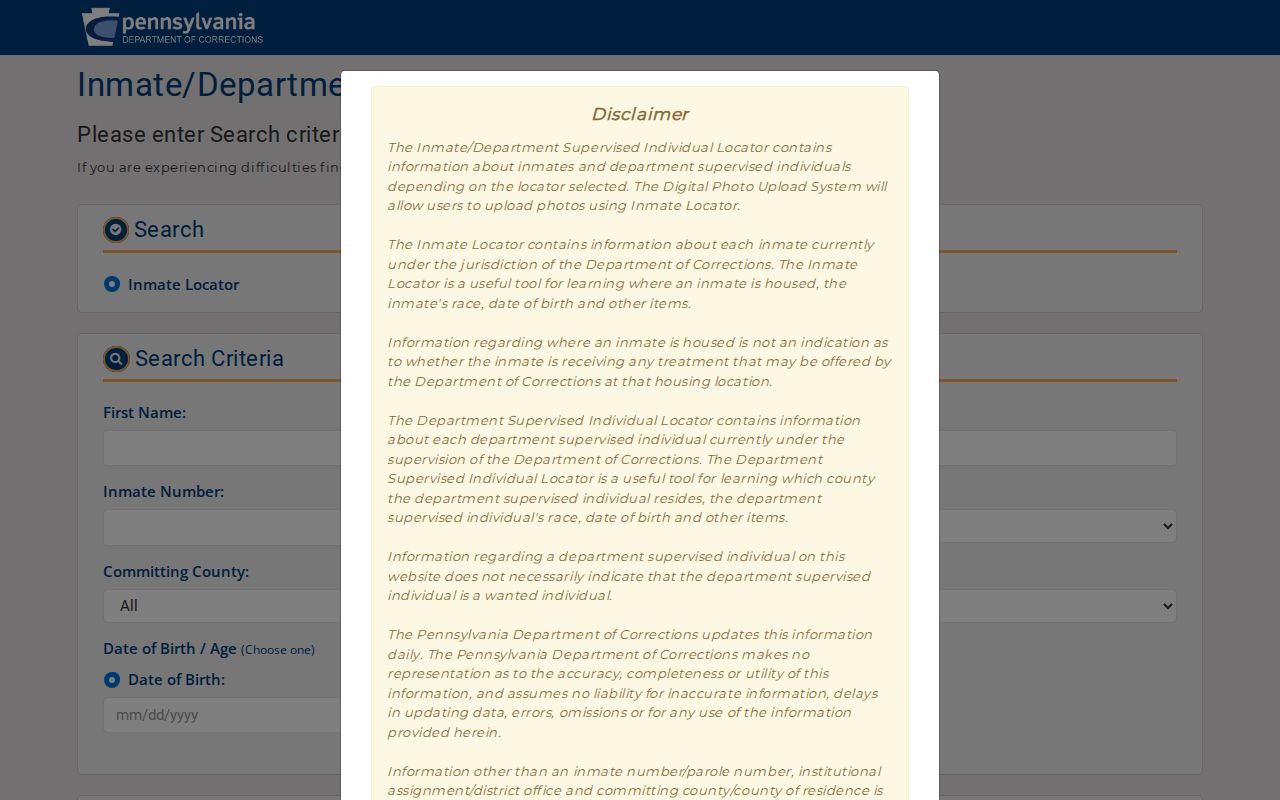
When the public search cannot answer the forecast question, the sound route is the judicial sentence, individual Board record, and PADOC computation, not an unofficial calculator.
Forest County Minimum Is Eligibility
Pennsylvania's judicial minimum ordinarily identifies the first parole-eligibility point, subject to offense and sentence exclusions and specialized laws. It is not a hearing promise. It is not a scheduled release appointment. The Parole Board may grant, refuse, defer, continue, or later rescind action as allowed by law and the record.
The Parole Board considers statutory factors listed in 61 Pa.C.S. § 6135, while § 6137 covers general parole authority and limits. Section 6139 addresses applications and reconsideration. Some case types use different decision tracks, and some specified parole types do not require an interview. The result for one person must come from that person's Board Action, not a presumed monthly calendar.
No public statewide parole-hearing calendar or searchable decision-results database was found. A minimum date cannot be used to fill that gap. If a state sentence, Board Action, PADOC movement record, and parolee Release Date differ, preserve the labels: eligibility, decision, institutional exit, and discharge are separate milestones.
Note: A prior release date never proves current freedom because later supervision action, a warrant, or new custody may follow.
Forest County Local Release Computation
No reviewed Forest County source publishes a local sentence calculator, good-time policy, weekend-release rule, or fixed release hours. It would be inaccurate to borrow any of those rules from a nearby county. Forest and Warren share the 37th Judicial District, but shared court administration does not prove which jail held a Forest County defendant or which facility computed a local term.
Start with the signed sentencing or bail order and the UJS docket. Record any commitment term, time-served credit, probation component, and later amendment. Then ask the Forest County Sheriff to identify the actual physical custodian. Give that custodian the case number, OTN, booking number if known, and a narrow date range. Ask for the agency's existing computation and records that show the release or transfer date.
Do not perform arithmetic from an incomplete docket. Concurrent and consecutive terms, amended orders, credit dates, and other holds can change an apparently simple result. A time-served order on the visible case may still coexist with a probation or parole detainer, another county case, an ICE hold, or an extradition warrant. Only the custodian or issuing authority can explain the lawful basis for continued custody.
If a local record says “released to another agency,” follow the receiving agency. County-to-SCI movement is continued state custody. Jail-to-ICE or jail-to-USMS movement is also continued custody. Keep the word “transferred” until community exit is separately verified.
Resolve Forest County Release Date Conflicts
Different official dates may each be correct within their own scope. The judicial minimum marks eligibility. A Board Action records the parole decision. PADOC records the institutional movement. The parolee locator may display an actual Release Date. A later record can show maximum expiration or discharge. Preserve those labels before deciding that two systems conflict.
Build a short timeline. Place the court authorization first, then the Board decision if applicable, the custodian movement, any PA SAVIN alert, and the start of supervision. Include each source and retrieval time. If a field is wrong, send the correction to its owner: court errors to the issuing court, PADOC data to PADOC, and local movement data to the physical custodian.
A public no-result also needs careful treatment. PADOC does not promise a permanent archive of every discharged person. UJS does not display sealed, expunged, or Clean Slate limited-access matters. A missing search result can reflect identity, timing, scope, or lawful access limits. It does not prove that confinement or release never occurred.