
Where SCI Forest Releases Go
Release from SCI Forest is governed by the Pennsylvania state sentence, PADOC processing, and the Pennsylvania Parole Board when parole applies. State parole means conditional liberty before the judicial maximum. It is a real release from institutional confinement, but it is not final discharge from the sentence. A parolee may move to an approved community plan and report through a state district office. The public parolee result can display a Release Date and supervision geography that help confirm that path.
Maximum expiration or another final discharge ends a different legal milestone. Public locator visibility may not form a permanent archive after full discharge, so PADOC records and the controlling sentence or Board documentation may be needed. A move from SCI Forest to another State Correctional Institution is only a transfer. The person remains in PADOC custody. A detainer, which is a hold from another authority, can also prevent community release even when a parole or court milestone has been reached.
| SCI Forest event | Custody effect | Best confirmation |
|---|---|---|
| Release to state parole | Institutional confinement ends under conditional supervision | PADOC parolee Release Date and Board Action |
| Transfer to another SCI | State custody continues | PADOC inmate location and movement record |
| Maximum expiration | The state sentence reaches its maximum, absent another custody basis | PADOC discharge record and court sentence |
| Release to another authority | PADOC control may end while other custody continues | Destination field and receiving-agency record |
Confirm an SCI Forest Release
The official PADOC inmate and parolee locator gateway covers Pennsylvania state-sentenced inmates and parolees. It does not cover a person held only in a county jail. The information is updated daily. A last name or inmate number is required on the inmate route, and a stable inmate or parole number is the safest way to narrow a common name. Compare date of birth or age and facility details before treating a result as a match.
- Search the inmate side by inmate number or last name, then confirm that the result identifies SCI Forest and the right person.
- If parole release is believed, switch to the parolee side and search by parole number or name and date of birth.
- Read the displayed Release Date, Current Location, Permanent Location, District Office, and Last Updated Time without changing their labels.
- Check the sentence docket and the individual's Board Action when the authority or timing needs to be established.
- Contact PADOC for releasable movement or discharge records when the public result cannot confirm final sentence discharge.
The current locator inspection found no field titled “Projected Release Date” or “Tentative Release Date.” The Release Date on a parolee record describes an actual parole-release-related event. It must not be turned into a forecast, minimum date, maximum date, or final discharge. The broader Forest County search paths and record distinctions appear on the Forest County released inmates home page.
Note: PADOC warns that some personal information may be self-reported, so use stable identifiers and confirm changing status with the agency.
SCI Forest Records and Contact
The institution is the direct contact for facility information, while PADOC is the source for state movement and release records. A useful request identifies the person by full name, inmate or parole number, date of birth, and a narrow time span. Ask for existing records sufficient to show the movement type, institutional release date and time when releasable, destination or receiving authority, and the record identifier tied to the event. For final discharge, preserve the agency's exact label rather than asking it to certify a broad claim about present freedom.
State Correctional Institution Forest
P.O. Box 307
286 Woodland Drive
Marienville, PA 16239
814-621-2110
Operated by the Pennsylvania Department of Corrections
The public profile does not publish a release desk, release door, or release-hour schedule. Do not infer a pickup point or time. For a state-record question that the public locator cannot answer, provide the stable number and ask PADOC for the proper records channel. Technical questions about the locator can be directed to the agency support address published in the research, ra-contactdoc@pa.gov. A court sentence and Board Action remain separate sources because the institution cannot rewrite a judicial order or Board decision.
The Pennsylvania UJS docket search can show sentence information, including minimum and maximum terms when entered on the public docket. The minimum is generally the first parole-eligibility point, not a promised release appointment. A grant can still be followed by planning, processing, or resolution of detainers. The maximum is a different milestone and should be recorded with its own label.
SCI Forest State Release Records
SCI Forest is a maximum-security Pennsylvania state institution for men. PADOC, not the Forest County Sheriff, operates it. That distinction controls every lookup. A Forest County arrest does not send a person to SCI Forest by default, and a web result for the prison does not identify the holder of a county defendant. Conversely, the county's lack of a published jail does not turn SCI Forest into a local detention service.
The official PADOC live locator has separate inmate and parolee functions. The parolee search can use Parole Number, name, date of birth, County, District Office, gender, and Release Date. Result details may include Parole Number, Release Date, Current Location, Permanent Location, Last Updated Time, age or date of birth, and gender. Some records may show a “Wanted: Parole Absconder” flag. That flag concerns a later supervision status and does not erase an earlier supported release.
- Parole
- Conditional community release before the state sentence reaches its judicial maximum.
- Discharge
- The end of the stated sentence or custody status recorded by the responsible authority.
- Transfer
- Movement between institutions or agencies while custody continues.
- Board Action
- The individualized Pennsylvania Parole Board record of a grant, refusal, deferral, rescission, or other decision.
SCI Forest Reentry Before Release
SCI Forest's Reentry Service Office works with people who are within 18 months of a minimum and/or release date. Reentry Parole Agents coordinate transition information, workshops, and community connections. This is an important local part of release preparation. It can help a person plan for the move from prison to the community and connect institutional work with post-release services.
The office does not set a sentence date and is not the Pennsylvania Parole Board. Its 18-month service window is also not proof that release will occur within that time. The judicial sentence, Board authority, PADOC computation, detainers, and release processing still govern the outcome. A family member seeking a date should use the official sentence and release-record routes, while program information should be treated as transition context.
The PADOC Bureau of Reentry Coordination explains the agency framework behind this work. After release to parole, state supervision geography may appear in the parolee locator. Forest County probation is a different county court service and should not be substituted for state parole. The Forest County post-release supervision route separates those two systems.
Note: Reentry services support transition and planning, but only the sentence, Board, and PADOC records can establish release authority and status.
Why SCI Forest History Matters
SCI Forest is physically prominent in the county, which makes jurisdiction easy to confuse. According to the official history, Forest County commissioners began seeking a state facility in 1998 after the loss of a major employer. The first prisoners arrived on October 28, 2004. Its prototypical design includes wagon-wheel cell units and security features. Those facts describe a state correctional institution located in Forest County, not a county-run jail.
The official PADOC SCI Forest profile documents the institution, contact, history, and reentry role.
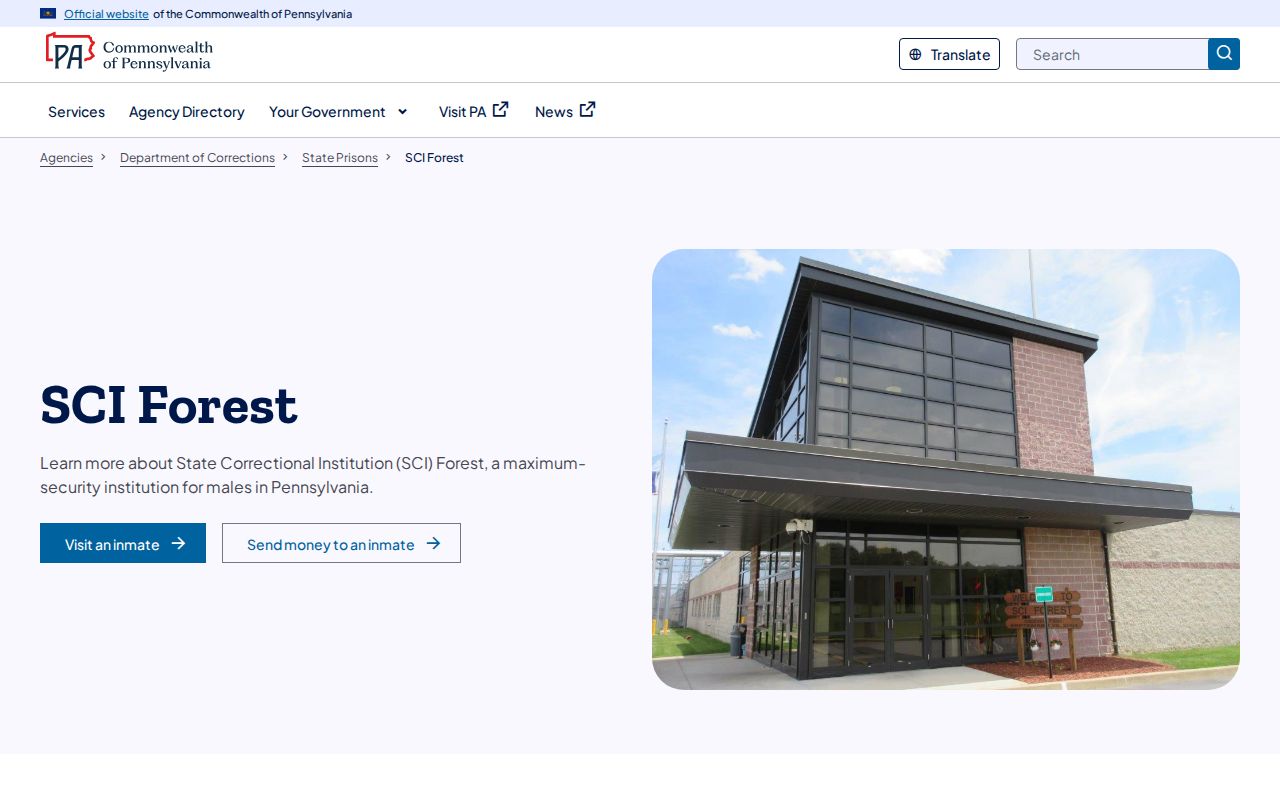
The captured profile anchors the correct operator and contact. It also helps prevent a local Forest County custody search from being diverted into a state-prison record simply because both share the Forest name.
Shared words do not create shared custody. A person at SCI Forest is held under PADOC authority. A person arrested in Forest County may have been housed by a different, presently unidentified physical custodian. The Forest County Sheriff is the routing contact for that local path, while PADOC is the records authority for this state-prison path. The county's district court information likewise describes the local court layer, not state-prison custody. Keeping these paths apart is essential to an accurate release claim.
Separate SCI Forest Transfer from Release
If a person no longer appears at SCI Forest but remains listed at another SCI, the event was a transfer. State custody did not end. If the person appears on the parolee side with a Release Date, the record supports release to conditional state supervision. If a fully discharged person no longer appears in a public search, absence alone proves nothing. Ask PADOC for a releasable movement or discharge record tied to the stable inmate or parole number.
Reconcile the state record with the judicial sentence and Board Action. Eligibility, Board decision, institutional release, supervision start, maximum expiration, and final discharge are separate milestones. They may carry different dates without conflict. Keep exact field names and retrieval times. A Board grant does not itself prove the door opened, while the public parolee Release Date should not be recast as a sentence forecast.
The best evidence chain is the PADOC movement or release record, the parolee result when applicable, the controlling sentence, and the person's Board Action. A PA SAVIN event may provide timely corroboration, but it is not a permanent discharge archive. A past release also does not prove current freedom because later supervision action, a warrant, or new custody can change the present status.